
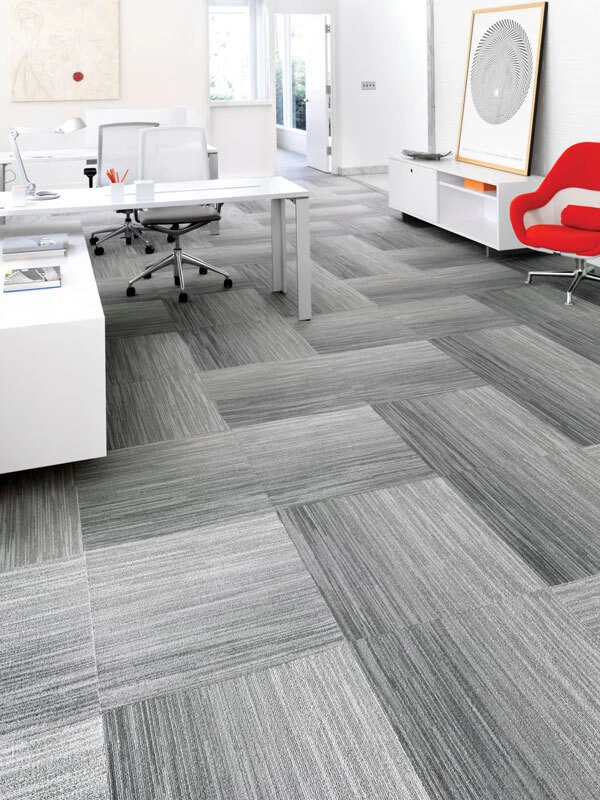
Broadloom carpet looks fine until the day a coffee spill, a chair caster, or a burst pipe ruins a section of it, and then the whole room is a problem. Carpet tile was built to solve exactly that. It's carpet broken into individual, replaceable squares, and for commercial spaces, that one difference changes the entire cost and maintenance equation. Here's what that actually means for a business deciding between the two.
Carpet tile was developed for commercial environments first, and that's still where it earns its keep. Offices, retail stores, healthcare facilities, and schools all share the same problem: high foot traffic, frequent spills or damage in predictable spots, and zero tolerance for shutting down a space to fix a small section of flooring. Broadloom works fine in a living room where wear is gradual and even. It struggles in a lobby that sees five hundred footsteps a day concentrated in the same three paths.
What makes carpet tile the practical choice in these settings isn't just repairability. It's also easier to transport, easier to store spares of, and easier to install in phases across a building that can't fully close for renovations.
Carpet tile offers a quick, straightforward installation for large commercial spaces, since crews can work section by section without waiting on massive rolls to be manoeuvred through hallways and doorways. For a space around 5,000 square feet, a realistic installation timeline runs just a few days, though exact timing depends on furniture, layout complexity, and how much of the space needs to stay accessible.
Businesses can often stay operational during installation because work can happen zone by zone, outside business hours or on weekends, with completed sections usable immediately. Phased installation is one of carpet tile's biggest practical advantages: crews can finish one wing or floor while another stays in use, and because tiles are manufactured to consistent dye lots, there's no visible line where Monday's work meets Thursday's.
Janitorial staff generally find carpet tile easier to maintain than broadloom because individual tiles can be lifted for cleaning underneath, spot-treated, or replaced without special equipment or scheduling a full floor cleaning crew. It also holds up well under standard commercial cleaning equipment, from extraction cleaners to routine vacuuming, without the same wear concerns that come with repeatedly cleaning one continuous broadloom surface. We will help find flooring for your residential or commercial space within your budget!
Because each tile is its own unit, mixing colours and patterns to create visual zones is straightforward in a way broadloom can't match without custom cutting and seaming. Reception areas, workstation zones, and boardrooms can each get a distinct look using the same base product line, which keeps costs predictable while still giving each space its own identity
Businesses also use pattern changes and colour shifts in carpet tile to guide foot traffic, marking a path from an entrance to a reception desk or defining a walkway through an open floor plan without needing separate flooring materials or transition strips. We stock coordinating collections designed with this in mind, so colours and patterns within the same line are built to work together rather than requiring a designer to hunt for matches.
Light commercial and heavy commercial carpet tile are rated differently, and the difference matters more than it sounds. Light commercial tile suits lower-traffic offices and meeting rooms, while heavy commercial tile is built for lobbies, main corridors, and retail floors that see continuous daily use. Rolling office chairs are one of the toughest tests for any carpet product, and commercial-grade tile with a dense, low-profile construction holds up to caster traffic far better than a plush residential-style pile.
Edmonton's entryway conditions add another layer. Tracked-in snow, salt, and slush during winter months wear down flooring fast near any commercial entrance, and carpet tile with a moisture-resistant backing handles this better than broadloom since damaged or salt-stained tiles near the door can simply be swapped without touching the rest of the floor.
Picture an office where a workstation chair has been rolling over the same three-foot patch of carpet for two years, or a retail entryway where salt and grit have worn a path from the door to the counter. With broadloom, fixing that means replacing an entire section, matching dye lots, and dealing with visible seams where old meets new. With carpet tile, you pull up the two or three damaged squares, drop in replacements, and the room looks new again in under an hour, often without moving a single desk or display fixture.
That replaceability adds up to real savings over broadloom section replacement, especially once you factor in the labour and downtime that comes with cutting into an installed broadloom floor versus lifting a tile. Most commercial buyers order five to ten percent extra tiles at installation specifically to have colour-matched replacements on hand for exactly this scenario, since dye lots can shift slightly over time and you want your spares matching the original run.
Open-plan offices have an acoustics problem that hard flooring makes worse and carpet tile genuinely helps with. The fibre structure and backing absorb sound rather than reflecting it, cutting down on the echo and noise buildup that comes with rows of desks and hard surfaces nearby. For call centres, shared workspaces, or any office layout without private offices, acoustic-specific carpet tile options exist with denser backing built specifically to manage noise in busier environments.