
Flooring For Life
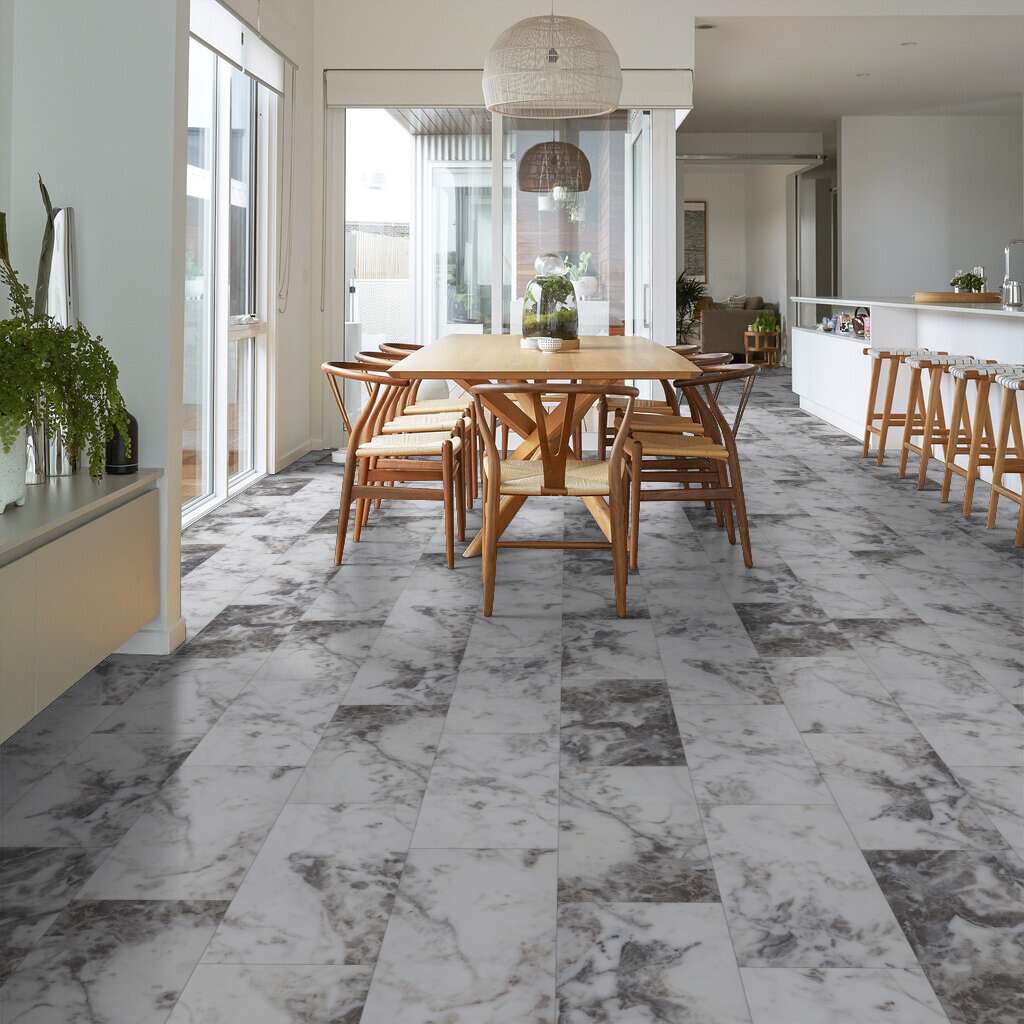
If you've been shopping for flooring and find yourself drawn to the look of stone, marble, or concrete but not the price, the weight, or the cold underfoot, luxury vinyl tile is worth a close look. LVT gives you the visual impact of natural stone with the comfort and practicality of vinyl. This page explains what makes it different, where it works best, and what to expect from it in your home.
The biggest reason people choose LVT over LVP is access to looks that planks can't replicate. A marble-inspired floor with realistic veining, a concrete-look bathroom, a travertine-style entryway. These visuals belong to tile format.
Modern LVT printing technology has come a long way. The high-definition print layers in today's products capture the variation, depth, and texture of natural stone in a way that would have been hard to believe a decade ago. Guests who don't know what they're looking at often don't know what they're looking at.
We carry a wide range of stone-inspired looks including marble options like Classico Carrara and Calacatta, softer stone looks like Limestone and Dove Nova, and neutral tile formats ranging from warm creams to deep charcoals. Large format tiles are increasingly popular right now, particularly in bathrooms and open-plan spaces, and we carry a full range of sizes. Fewer grout lines mean a cleaner, more seamless look and less maintenance, and larger formats tend to make rooms feel more spacious. Come in and see what's currently in stock, or talk to one of our consultants about what would work best in your space.
This is the question most people want answered before they buy. The short version: modern LVT looks significantly better than people expect, especially once it's installed in a full room.
The high-definition print layer captures the variation and depth of natural stone, and the embossed texture on the surface means you can feel dimension underfoot rather than a flat printed surface. It's not identical to real stone, and in a side-by-side comparison you'd notice the difference. Installed on a floor with standard lighting and furniture, most people can't tell.
Underfoot, LVT is noticeably different from real ceramic or porcelain tile. It's warmer, softer, and quieter. In a bathroom or kitchen where you're standing for long periods, that difference is something you feel every day. In Edmonton where floors get cold in the winter, the warmth of LVT over ceramic is a real practical advantage.
LVT is at home in any room where you want a stone-inspired look and need a floor that handles moisture without complaint. Bathrooms, kitchens, laundry rooms, and entryways are the most common applications, and for good reason. The 100% waterproof core means spills, splashes, and the humidity of a busy bathroom aren't a concern.
Entryways and mudrooms are another strong fit. The tile format handles heavy traffic well, cleans up easily, and the stone-look visuals hold up well even in a high-use area.
LVT works in living rooms and bedrooms too, though it's less common there. If you love the look of stone or large-format tile throughout your home and want visual continuity from the kitchen into the main living areas, it's a perfectly functional choice. It's a little cooler and harder underfoot than carpet or LVP, which is worth factoring in for bedrooms especially.
For small bathrooms, larger tile formats generally make the room feel bigger by reducing the number of grout lines in the visual field. A larger format tile in a compact bathroom reads as more spacious than a smaller tile in the same space. Our consultants can recommend the right size for your specific room dimensions.
LVT and LVP share the same core construction. Both are 100% waterproof, both use a high-definition print layer over a rigid vinyl core, and both are built to handle everyday wear without the fragility of natural materials. The difference is format and what that format makes possible.
Planks are built to mimic wood. Tiles are built to mimic stone, ceramic, marble, slate, concrete, and other hard-surface looks that simply don't translate convincingly into a plank shape. If the floor you're imagining has a tile layout, tile grout lines, or a stone-inspired visual, LVT is the product that gets you there.
TThe choice between LVT and LVP usually comes down to the look you want in the room, not a performance trade-off. In most cases they perform comparably. The question is whether you're going for a wood-inspired floor or a stone-inspired one.
One thing worth knowing: you can use both in the same home and even transition between them in adjacent spaces. Wood-look planks in a living room flowing into stone-look tile in a kitchen or entryway is a common and very effective design choice. Come in and we can show you combinations that work well together.
One of the advantages of tile format over plank is layout flexibility. LVT can be installed in straight set, offset, diagonal, and herringbone patterns depending on the product and the space. A diagonal layout in a smaller room creates the visual effect of more floor area. A herringbone pattern adds texture and interest to a larger space. Our consultants can walk you through what works best for your room before you commit to anything.
Finishes range from matte to lightly textured to higher gloss depending on the product line. Matte and textured finishes tend to be the most popular for residential spaces because they hide minor scuffs and footprints better than a glossy surface. That said, a higher gloss finish in the right space, like a sleek modern bathroom, can look exceptional.
You can also mix tile colours or patterns within the same installation to define zones, create borders, or add visual interest. An inset border in a bathroom or a contrasting tile zone in an entryway are both straightforward applications that make a real design impact. Bring us a photo of your space and we can help you think it through.
We carry groutable LVT options that are designed to be installed with grout between the tiles, creating an appearance that's essentially indistinguishable from real ceramic or porcelain at a glance. If you want the most realistic possible stone or tile look, this is how you get there.
The grout used with LVT is an acrylic grout rather than standard ceramic tile grout. Standard grout can crack over time because LVT has slightly more flex than a ceramic substrate. Acrylic grout moves with the floor rather than against it, which means it stays looking good long-term. We can order acrylic grout in the colour of your choosing to match or complement your tile selection.
Grouted LVT is easy to maintain. Regular sweeping and damp mopping keeps it looking clean. The acrylic grout is more stain-resistant than traditional grout, so the maintenance is less involved than you might expect from a grouted floor.
LVT and ceramic or porcelain tile often compete for the same spaces, so the comparison is worth laying out clearly.Durability-wise, ceramic and porcelain are harder and more scratch-resistant at the surface. They'll outlast LVT in the most extreme commercial applications. For residential use and most commercial settings, the difference is largely academic. Both perform well under normal conditions.
Where LVT consistently wins is comfort and warmth. Ceramic tile is cold and hard. In a bathroom on an Edmonton winter morning, that's noticeable. LVT is softer underfoot, warmer to the touch, and quieter to walk on. For spaces where you stand for long periods, it's meaningfully more comfortable.
Ceramic tile can chip. A heavy dropped object on a ceramic floor can do real damage. LVT is more forgiving in that regard, and individual tiles are much easier to replace if one does get damaged.
LVT is also more budget-friendly than most ceramic and porcelain options, and the installation is faster and less involved. No mortar, no long cure times, and the subfloor prep is less demanding than ceramic requires.
LVT works with radiant floor heating the same way LVP does. Keep the surface temperature within the manufacturer's spec and you're good. Ceramic tile is also compatible with radiant heat, so this one is a tie.
Luxury Vinyl Plank (LVP) & Luxury Vinyl Tile (LVT) are extremely low maintenance and easy to clean. Regular sweeping and the occasional mop and warm water are all it takes. You can spend your time doing what makes you happy!
You can prevent dents and damage to your luxury vinyl flooring by using felt pads on the legs of your furniture and appliances.
For more info on brand specific cleaners, our Flooring Consultants can help you out with answers and brochures.
Luxury Vinyl Plank (LVP) & Luxury Vinyl Tile (LVT) warranties usually cover against manufacturing defects and normal wear and tear (such as delaminating, and loss of original pattern and colour). Also, some manufacturers warrant that floating product joints will stay watertight.
In Stock there are several styles of Vinyl Tile and Vinyl SuperPlank for your quick pick up and do it yourself residential or commercial projects. Or, let our Flooring Consultants arrange professional installation for you. If we don't have the vinyl plank or vinyl tile flooring you're looking for, we can special order it for you! Our 12,000 sq. ft. showrooms display many options to suit your personal style, home and budget. Call our Edmonton flooring stores or request a quote!