FIND THE RIGHT PRODUCTS FOR YOUR PROJECT
Shop All Commercial

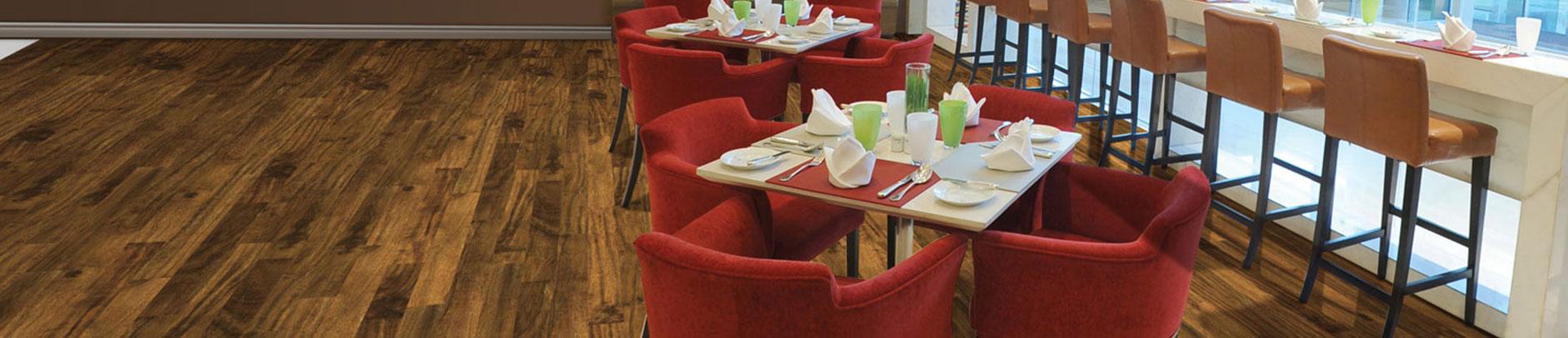
Options for All Types of Businesses

Commercial flooring is built, rated, and warrantied for business use, which means heavier wear layers, higher traffic ratings, and warranty terms written for commercial spaces. Flooring Superstores carries broadloom carpet, carpet tile, commercial vinyl plank and tile, linoleum, Marmoleum, and matting at two Edmonton showrooms. Our Flooring Consultants help you match the product to your traffic, your budget, and your timeline, and our professional install crews handle the work.
A commercial product is tested for sustained traffic, rolling loads, and daily cleaning. Residential flooring is not, and that gap shows up in two places. The first is performance, since a thinner wear layer or lighter construction wears down faster under constant foot traffic. The second is the warranty, because many residential warranties exclude commercial use, so a failure in a business space may not be covered at all.
Commercial flooring often costs more upfront, but it is engineered to last through that kind of use. It also does not have to look institutional. Today's commercial vinyl plank, carpet tile, and linoleum come in wood looks, stone looks, and a wide range of colours, so a client-facing space can look polished and still hold up.
A traffic rating is a tested classification, not a headcount of people per day. Commercial flooring is commonly rated in classes. Class 32 is general commercial use, Class 33 is heavy commercial use, and Classes 41, 42, and 43 are industrial, with each step up asking more of the floor.
Rating tells you what a product has been tested for. It does not tell you how your space will treat it, so the better question is what will cross the floor every day. Rolling carts, office chairs, high heels, pallet jacks, and constant foot traffic each wear a surface differently. Tell your Flooring Consultant what your floor will face, and they can match the product and grade to it.
Flooring work should not close your doors for longer than it has to. Our professional install crews can phase a project by area, so part of your space stays in use while another is being done. We schedule around your business hours, and the timeline depends on the product, the size of the space, and the condition of the subfloor. Your Flooring Consultant will go over timing with you when you request an estimate, so you can plan staffing, deliveries, and customers around it.
From October to April, every person who walks in brings snow, salt, sand, and moisture with them. Left alone, that grit works its way across the floor and wears down the finish, and the moisture can leave surfaces slippery. Commercial matting and runners at building entrances catch much of it before it travels further in, which protects the flooring in the rest of your space and makes daily cleaning easier.
Price per square foot is one line in the budget. The full cost over ten years includes installation, cleaning and maintenance, repairs or replacement of worn sections, and any business downtime during installation.
Spending more upfront saves money when the product lasts longer or costs less to maintain. It does not always, which is why the comparison is worth doing for your space. Add up the purchase, installation, and ten years of upkeep for each option, then divide by the years you expect it to last. That number is more useful than the sticker price.
Commercial warranties are written for business use, and they usually come with conditions around proper installation and maintenance. Using a residential product in a commercial space can void coverage, so check the terms before you buy.
Fire ratings, slip resistance, and accessibility requirements vary with the type of building and how it is used. Condo boards and property managers often have their own flooring specifications as well. Confirm what applies to your project with your contractor or the building authority, and bring that list to your Flooring Consultant so the product you choose meets it.
The right product depends on what happens on the floor every day. Here is how the choice tends to shift by space.
Rolling chairs are the main test in an office. Carpet tile, broadloom, and commercial vinyl plank all work, and the decision often comes down to sound. Carpet absorbs noise in open-plan layouts, while hard surfaces reflect it, so many offices use both, with carpet in work areas and a harder surface in reception and corridors.
Retail floors take foot traffic, shopping carts, and dollies, often all in the same day. Commercial vinyl plank, vinyl tile, and carpet tile are common choices, and many stores use different products in the sales area, fitting rooms, and stockroom.
Grease, oils, and spills put slip resistance and cleanability first, and commercial kitchens carry health code requirements. Confirm what applies to your space before you choose a product, and our Flooring Consultants can walk through the options with you.
Hygiene, slip resistance, and low-maintenance surfaces matter most in medical offices, schools, and care facilities. Linoleum, Marmoleum, and vinyl tile are frequent choices because they can be installed with few seams and cleaned easily.
Forklifts and heavy equipment call for tough, high-rated surfaces. Matting and runners add comfort and traction at workstations where people stand for long shifts, and they protect the flooring underneath.
Offices inside a retail floor or a showroom inside a warehouse usually need more than one product. We can help you choose flooring for each zone and plan the transitions between them.
In many cases, yes. Phased installation lets us work on one area at a time while the rest of your space stays in use. The right approach depends on the size of the space and the product, so raise it early in your estimate.
Plan as early as you can, especially when the work is tied to a renovation, a move-in date, or a contractor's schedule. Large projects may involve special ordering, and an early conversation gives everyone room to line up product, crews, and timing.
Broadloom is rolled carpet installed as a continuous surface, and carpet tile is installed in individual squares. Tile makes it easier to replace a damaged section and to build colour and pattern zones, while broadloom suits spaces that want a seamless look. Both are strong choices, and your Flooring Consultant can help you weigh them for your layout.
Start with what the floor will carry: foot traffic, rolling chairs, carts, or equipment. Share that with your Flooring Consultant, and they will recommend a product and grade that fits.
Our Flooring Consultants can give you an accurate quote when they know a few things about your project:
If you are managing a larger project, tell us early so we can plan special orders and scheduling with your contractor or building team. Request an estimate and a Flooring Consultant will follow up to talk through your space.